
The Science Behind the Emotional Memory Bank
The EMB is built on a scientific truth
the marketing industry has overlooked for decades.
What makes people feel something before they even know why.
THE FOUNDATION
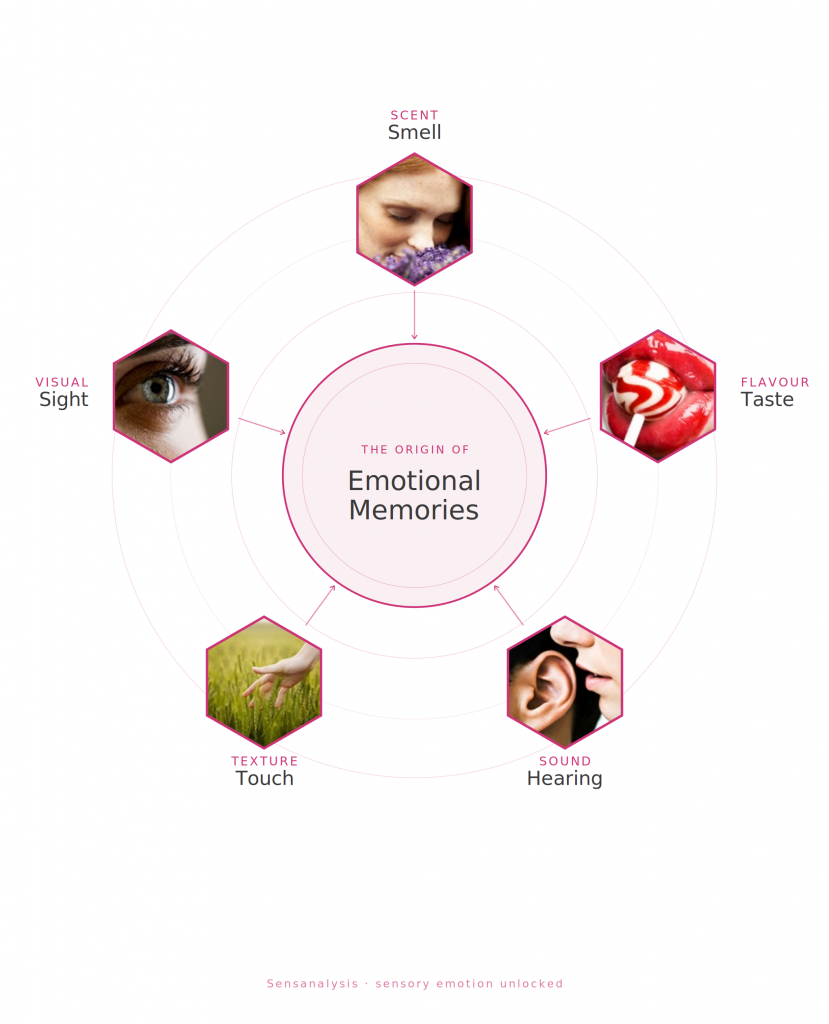
The brain stores emotion through the senses.
Every time a person smells, tastes, or touches something, their brain does something remarkable. It does not just register the sensation. It cross-references it against every emotional memory already stored from a lifetime of experience.
A fragrance does not just smell good. It recalls. A texture does not just feel soft. It reassures. A visual does not just look appealing. It triggers a subconscious expectation of how the product will smell, taste, and make the consumer feel, before they have even touched it.
This happens in milliseconds. The consumer is not aware of it. But it determines everything that follows.
“Odour is to emotion what vision is to cognition.”
Trygg Engen · 1982
Marketing has spent decades perfecting two senses: sight and sound. These are cognitive senses. They capture attention. But they do not create emotional bonding. Only sensory emotion does that. And sensory emotion lives in the other three, even as expectations: smell, taste, and touch.
KEY CONCEPT
The consumer judges your campaign before they meet your product.
When a consumer sees a campaign image, their brain does not just process what they see. Within milliseconds, it predicts what the product will smell like, taste like, and make them feel, based on emotional memories already stored from a lifetime of sensory experience. This is not imagination. Every visual triggers subconscious emotional expectations.
If the product delivers on that expectation, resonance is created. If it does not, consumers lose interest before they can even articulate why.
WHAT THE CONSUMER SEES
Your campaign visual
What their brain does
Subconscious emotional prediction
What determines the outcome
Whether expectations match reality
The SENSANALYSIS platform offers the opportunity to unlock these sensory emotion expectations before launch, and tell you whether your campaign will deliver on it and how to select and improve it.
How the data was gathered
Twenty years of taking consumers on a sensory journey.
Building the Emotional Memory Bank required a method unlike anything in conventional market research. The goal was not opinions. It was not reactions. It was access to the deepest layers of emotional memory, through the only door that leads there: the senses.
Data collection began in 1984 and continued for over 20 years, across 17 countries, with thousands of carefully selected consumers. The process evolved as new product categories and new markets were added, but the core principle never changed: high-quality input produces high-quality output.
The collection process Style
STEP 01
Consumer screening
Each recruited consumer of clients’ target group passed an additional proprietary screening test designed to identify consumers who are skilled in distinction and articulation of a sensory perception in every single detail. Most people feel things. Very few can describe those feelings with precision.
STEP 02
Clean room environment
Participants entered a plain, neutral space with no distractions, no intercommunication, no moderation. Nothing to anchor the experience to prior knowledge. Just the consumer, a stimulus, and their inner world.
STEP 03
The sensory journey
Participants were guided by an online evaluation guide on a sensory journey designed to bypass cognitive filtering and access the emotional memory directly.
STEP 04
Emotional recall
What came back was extraordinary. Participants wrote long essays forgetting that they were evaluating a product. They described beach holidays, weddings, and their mother’s kitchen. The stimulus had taken them somewhere with all 5 senses vividly present
STEP 05
Encoding and structuring
The qualitative data was encoded, structured, and built into a growing library which has become an Algorithm. After 20+ years all digitally available and collated data, have now formed the Emotional Memory Bank.(EMB)
INSIDE THE EMB
What the database actually contains, and why it cannot be replicated.
Emotional memory imprints
The subconscious emotional memories and associations consumers form when confronted with any kind of stimuli: a concept, a pack, a product. Not what they say they feel. What they actually feel, captured before the cognitive brain censors it.
Sensory emotion profiles
Structured emotion profiles for thousands of sensory stimuli across personal care, home care, fragrance, and food and beverage. Each stimulus mapped against 20+ emotional dimensions and their memory associations.
Natural language emotion descriptions
Thousands of pages of qualitative descriptions translated by specialist translators to capture the finest nuances. Encoded into a structured NLP layer that the platform draws on to generate natural language and creative direction.
Consumer expectation vs reality mapping
Paired data sets showing what consumers expected before experiencing a stimulus, and what they felt after. This brand harmony gap data is the engine behind the platform’s predictive accuracy especially for CPG companies.
Cultural and seasonal context layers
Sensory emotion shows universal human reactions. The EMB contains cultural nuance data from 17 countries, allowing the platform to account for how the same sensory stimulus lands differently across markets.
Cross-category sensory benchmarks
Performance benchmarks built from 88 product categories and 17 countries. When the platform scores a campaign, it scores it against this reference library. The benchmark is not modelled. It is real.
Why this cannot be replicated
This data does not exist
anywhere else.
You cannot train an AI on synthetic data to produce this. You cannot scrape it from the internet. You cannot run a survey to generate it.
Over 20 years. In 17 countries. Across 88 product categories. With consumers who had a gift: the ability to put sensory emotion into words.
There are no comparable datasets that translate concepts, visuals, and products into validated multisensory emotional responses and back again, in a structured, scalable way. This makes EMB a non-substitutable asset, unavailable through public or commercial data markets, and a clearly defensible source of competitive advantage.
No new data collection has been required since 2020. The database is complete and will be automatically updated. With AI, the data is scalable and accessible in real time.
High-quality input produces high-quality output. The rigour of the collection methodology is the reason the platform predictions hold.
THE QUALITY OF THE DATA
Built with the world's leading consumer brands.
Proven over decades.
The EMB was not built in isolation. It was built in service of real product development challenges for some of the largest consumer brands in the world. That is what makes it commercially grounded, not just academically rigorous.
Real consumer evaluations. Not modelled. Not synthetic.
Countries. Cross-cultural emotional benchmarks built in from the start.
Product categories. From fragrance to food and beverage to personal care.
Collected across CPMG / FMCG
HIGH QUALITY IN, HIGH QUALITY OUT
What the platform receives.
What you get back.
SENSANALYSIS your campaign assets and runs them through the full depth of the Emotional Memory Bank. The output is not a score. It is a complete sensory emotion profile that tells you exactly how your campaign will land, and what to do about it.
What you upload
Possible options to input
- Campaign images and visuals
- Video or moving content
- Product concept or brief
- Pack design or prototype
- A short 1 to 2 question product evaluation
- Pre launch questionaire
- Mood boards and creative direction
What you receive
Your emotional intelligence output
- Emotional response breakdown by dimension
- Memory and association mapping
- Success index
- Expectation vs reality gap analysis
- Campaign performance prediction
- Product claim ideas and creative direction
Why no one else has this
Three things that make the EMB impossible to replicate.
The consumers
Each participant was identified through a proprietary screening process that tested for the specific ability. They were not standard panel respondents. The data they generate reflects a depth of emotional access that typical consumer research and standard panels never reach.
The method
The sensory journey methodology was developed over decades. It is not a survey format, a focus group, or an online panel. It was a carefully designed process built entirely on qualitative in-depth consumer evaluations, guiding participants into a state where emotional memory surfaced naturally. The outputs were not answers to questions. They were inner narratives from evaluations of over one hour of pure emotional recall.
The time
The EMB accumulated across real product development projects, across real markets, across real product categories, and is validated and proven over two decades of commercial practice. Every data point was gathered in service of a genuine client challenge. The result is a database that is not just deep, it is commercially validated.
Put the EMB to work
Ready to know how your campaign will feel before it launches?
The pilot opens Sept 2026. A limited number of early access partners are being selected now.